
Decoding the Young Nervous Sistem: The science of emotional regulation.

THE NEURO-PHYSIOLOGICAL FOUNDATION
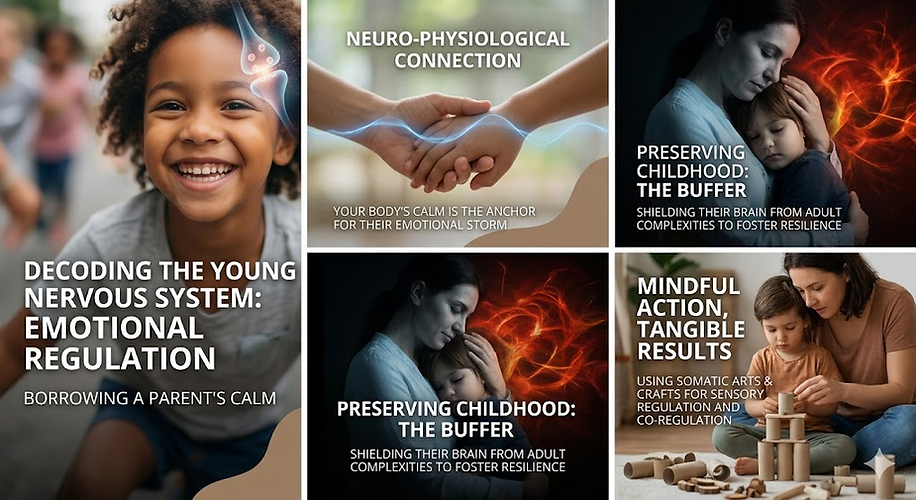
To understand emotional regulation, we must look at the brain as a biological command center. For a child, the prefrontal cortex—the area responsible for logic, impulse control, and executive function—is still under significant construction. When a child experiences "big feelings," they are often functioning entirely from the limbic system, the brain's emotional and emotional survival hub.
Emotional regulation is not a behavioral choice; it is a neuro-physiological milestone. It is the ability of the nervous system to modulate its state of arousal, moving from a high-energy "fight or flight" response back to a state of homeostasis or calm focus. Because children lack the neurological maturity to do this alone, they rely on co-regulation: the process of borrowing the regulated nervous system of a trusted adult to stabilize their own.
THE IMPACT OF EXTERNAL STRESSORS
The young nervous system is exquisitely sensitive to the environment. External stressors—including the "invisible weight" of adult life—can profoundly impact a child’s development.
The Echo of Stress: When adults carry chronic stress, their tone of voice and non-verbal cues change. A child’s nervous system perceives these subtle shifts as environmental threats, often triggering traumatic or defensive responses even in safe settings.
Cognitive Overload: Asking a child to process complexities that correspond to adult lives creates "noise" in a brain that should be focused on exploration.
The Buffer: Our primary role as adults is to act as a neuro-physiological buffer. By shielding them from adult-level stressors, we allow their brain to remain in the "growth and repair" state rather than a "survival" state.
HOW THE UPYK METHOD™ FACILITATES REGULATION
Our science-based somatic educational method is designed to transition the nervous system from high-energy states to calm focus through a specific 30/30/30 structure:
1. DECOMPRESSION THROUGH MOVEMENT (30 MIN YOGA)
We utilize specific yoga postures and breathing techniques synced to promote the decompression of the nervous system. This stage provides a physical outlet for accumulated stress hormones, allowing the body to "reset".
2. SENSORY GROUNDING (30 MIN ARTS & CRAFTS)
Engagement with kinetic art and tactile, recycled materials provides essential sensory input. By focusing on the texture and creation of art inspired by figures like Alexander Calder or Henri Matisse, the child’s brain moves from abstract emotional overwhelm to concrete, present-moment tasks.
3. COMMUNITY CO-REGULATION (30 MIN CONNECTION)
The final stage focuses on community connection. This reinforces the social engagement system of the brain, teaching the child that safety is found in connection with others.
PRACTICAL ACTIONS FOR PARENTS
Regulate Yourself First: Your neuro-physiology is the anchor. A calm, steady heart rate in the parent is the most powerful tool for a child's regulation.
Protect the Tone: Be mindful of your tone of voice. A soft, melodic prosody signals safety to the child's brain.
Prioritize Play: Remember, your child is only a child. Let them explore the world through the lens of wonder rather than the lens of adult responsibility.
By utilizing science-based techniques rather than mystical interpretations, we provide children with the actual tools needed to navigate their neuro-biological responses. #upsidedownyogakids #neuroplhysiology #emotionalregulgation #somaticeducation #oreservechildhood #scuencebasedparenting


Comments